
You
have subscribed to Joe Ross' Weekly Spread Scan Newsletter.
If you have problems reading this newsletter, please follow this link:
Spread
Scan Issue: November 20, 2006 - Volume 119
To unsubscribe, scroll past the end of this newsletter and click the "unsubscribe" link.Otherwise, welcome to this week’s issue of the
Joe Ross Spread Trading Newsletter.Each week we present spread trading examples and opportunities in order to help you become a more professional spread trader.
Be sure you receive all your issues of Spread Scan so that you can continue to enjoy learning through the best free educational trading information available, and so that we can keep you informed about additional educational services and products to help you grow as a successful and profitable spread trader.
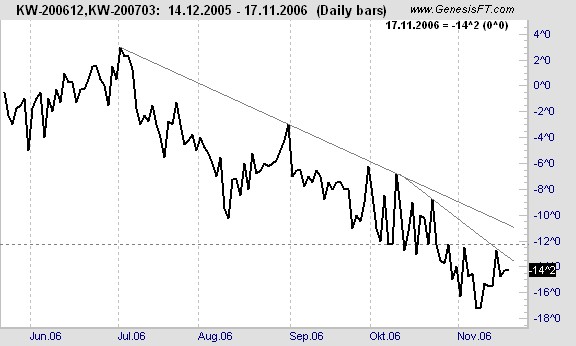
Today we consider an intra-market wheat spread: long December 06 Kansas Wheat and short March 07 Kansas Wheat (KWZ6 – KWH7). We see on the chart above that the spread has been in a down trend since July 06. After building a support area at around –12 in October, the spread made a new low in November 06, and the support of October became resistance in November. Now, regarding seasonality, the spread has the potential to move up. Will the spread start its seasonal move after breaking out of –12?
Traders may want to enter the spread at a break out of –12. Margin for the spread is $125 (reduced margin). Suggested risk is $200. Initial projected objective is $200, then a move to 5 or higher. Basis is seasonal (app. 11/5 – 12/5) and a 1-2-3 low. First Notice day for December Wheat is 11/30.
On November 13 we told subscribers of our daily newsletter, Traders Notebook, "Consider entering an intra-market meats spread LHJ7 – LHG7 at MOC on Monday 11/13. Margin for the spread is $675 (reduced margin). Suggested risk is $400. Initial projected objective is $400, then a move to 6.0 or higher. Basis is seasonal (app. 11/10 – 1/10) and a break out of the June and October high. Comment: As you can see on the first chart below, the spread broke out of its June and October high. Seasonality looks strong. But let’s have a look at the second chart below. We see both outright futures LHJ7 and LHG7. What we can see is the following: Whenever LHG7 moves down, the spread moves up. Whenever LHG7 moves up, the spread moves down. This is typical for a bear spread. The question is, what will happen now with LHG7? Will it keep on moving down after breaking out of its range? If so, the spread has a good chance to move higher. Conservative traders can wait for the next RH to enter (together with a possible 1-2-3 high in LHG7."
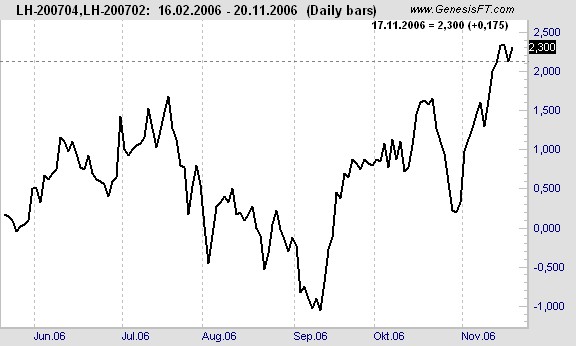
Here's how we suggested managing this trade:
11/13 In?
11/17 Suggest moving the stop to 2.125Open equity on remaining contracts: $120 per contract.
For more information about our daily newsletter, read on below or visit
http://www.spread-trading.com/tradersnotebook/index.htm

Questions or Comments? Please email us: support@spread-trading.com
Here is an interesting article from Joe Ross:
MANAGED MONEY
I often hear from students by letter, telephone, and in person at seminars, that they greatly desire to trade managed money.
At the opposite end of the spectrum, I also hear from students who want money managed for them. In either case, the experience can be gut-wrenching.
The psychological basis for successful trading is indeed a delicate subject. No one I have ever heard of has been able to pinpoint exactly what it is that gives one trader success while another trader fails. Although some claim to have done this, coming up with an attribute profile of the “average” winner, no one I know of has identified a set of common denominators among professional winning traders. Besides, which of us is “average?” Is it you?
Winning in the markets seems to involve a fine balance of traits that differ among winning traders. To make the identification of winning traders even more complicated, there seems to be a distinction between those traders who can successfully trade their own money and those traders who can successfully trade the money of others. I have met both.
Two of the most successful money managers I know personally began by trading managed money. They began trading other people's money for lack of sufficient money of their own with which to trade. Later in their careers, when they did have sufficient money with which to trade their own account, they found that they failed miserably. They were not able to trade their own money with any degree of success. More than that, when they traded their own money simultaneously with trading managed money, they failed at both.
Upon further investigation, and after speaking with a number of traders who have tried both, I discovered that there are many traders who are successful at trading managed money, but who habitually lose when trying to trade their own money. Invariably, upon further probing, some admitted that they were much more daring and courageous with other people's money than they were when the money was their own. By contrast, in this group of those who trade better for others than themselves, I have been able to identify traders who said they were much more careful and conservative with the money of others than they were with money of their own.
So within this group of traders, all of them students of mine who can successfully trade managed money, some are successful because they are more daring with the money of others, and some are successful because they are more careful with the money of others.
Next, we come to those traders who successfully manage their own money and who have attempted to manage money for others, but failed.
Why is it that a trader who can wonderfully trade his/her own money can fail at trading the money of others? I have agonizingly wrestled long and hard with this question. I have spoken with students who have had this experience. Amazingly, the answers are the same as with the group who successfully manage money. Managed money is a "monkey on their back."
They trade too carefully, too conservatively when the money is not their own. Worse than that, when things go wrong with a trade, they do not act rationally and with the same cool determination as with their own money. When they trade their own account, they do not think of it as money. When they trade someone else's account, all they can think of is that it is money, it is not their own, and they try their hardest to not lose it. Unfortunately, experience shows that what is feared the most happens – they do lose it.
Among my students and acquaintances I have identified at least four categories of traders who attempt to manage money. I'm sure there are other categories, but these are the ones I've found.
1. Those who successfully manage money for others but cannot manage their own account with any great degree of success because they are too careful with their own money, while they are more daring with the money of others.
2. Those who successfully manage money for others but cannot manage their own account with any great degree of success because they are too daring with their own money, while they are more careful with the money of others.
3. Those who successfully manage their own money but fail with managed money because they are too careful when managing money for others.
4. Those who successfully manage their own money but fail with managed money because they are too daring when managing money for others.
Conclusions:
Among those students I interviewed, I found none who successfully traded both managed accounts and their own accounts. The size of the population for this study was too small to come up with any meaningful statistics, but there are some warnings and cautions that can be concluded.
To those of you who want to have your money managed, be aware that the individual success of any trader trading his/her own money is no guarantee that that person can successfully manage your money. It would seem to bear out the advice of placing managed money with a proven successful trader of managed money.
To those of you who want to manage money for others, be aware that successfully trading your own account is no guarantee that you will be able to successfully trade someone else's account.
Failure in either of these situations is painful for all concerned! In fact, the pain can be so great as to prematurely end the trading hopes of either party.
Please, be careful about getting involved with managed money, whether you try to manage other people's money, or whether you want someone else to manage yours. The costs can be horrendous.

Let me introduce a great online trading course you need to study for your trading business operated in today's markets. I call it "From the Beginning," but don't let the name fool you. The course has information for traders at all levels, from beginners all the way through to advanced. There is much basic detailed information about this business that most traders do not know, and are unaware that they need to know. IF YOU'RE LUCKY YOU MIGHT FIND THIS INFORMATION IN BOOKS You can increase your chances for trading success when you know and understand the business of trading. The more you know, the better off you will be. You need to know the rules and the players; you need to know what can hurt you and what can help you. Follow this link to order YOUR COURSE "From the Beginning" NOW!
|

Join our Trading Community Forum at Trading Educators!

© 2006 by Trading Educators, Inc
Contact
Us
1509 Jackson Drive
Cedar Park, TX 78613
Phone: 800-476-7796 or 512-249-6930
You
can e-mail us: support@spread-trading.com
Office hours are Monday - Friday 9 A.M. to 5 P.M., U.S.C.T.
Unsubscribe or change subscription
To change your subscription or to unsubscribe, scroll past the end of this
newsletter to click the "unsubsribe" link.
Disclaimer:
The Commodity Futures Trading Commission has asked us to advise you that trading spreads is complex and carries a high degree of risk. While there is opportunity for incredible wealth building, there is also the risk of losing even more than you invested. Of course, that's not unlike most other businesses. But informed traders are the best traders!