
You
have subscribed to Joe Ross' Weekly Spread Scan Newsletter.
If you have problems reading this newsletter, please follow this link:
Spread
Scan Issue: February 28, 2007 - Volume 133
This email was sent to you by Trading Educators.
To ensure delivery to your inbox (rather than to bulk or junk folders)
please add info@spread-trading.com to your address book.To unsubscribe, scroll past the end of this newsletter and click the "unsubscribe" link.
Otherwise, welcome to this week’s issue of the
Joe Ross Spread Trading Newsletter.Each week we present spread trading examples and opportunities in order to help you become a more professional spread trader.
Be sure you receive all your issues of Spread Scan so that you can continue to enjoy learning through the best free educational trading information available, and so that we can keep you informed about additional educational services and products to help you grow as a successful and profitable spread trader.
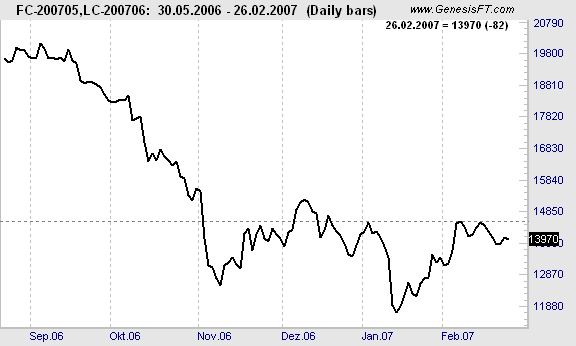
Today we consider an inter-market meats spread: long May 07 Feeder Cattle and short June 07 Live Cattle (500*FCK7 – 400*LCM7). This spread normally reaches its low in March before it starts the seasonal up move thru April and May. Will seasonality help to move the spread above the double top of February, and will this be the start of its seasonal up move?
Traders may want to enter the spread at a value of $14,600. Margin for the spread is $2,633 (no reduced margin). Suggested risk is $1,200. Initial projected objective is $1,200, then a move to $20,000 or higher. Basis is seasonal.
On February 01 we told subscribers of our professional daily spreads & position trading newsletter, Traders Notebook, "Consider entering an intra-market soybean spread SN7 – SX7 at a spread value of –23. Margin for the spread is $338 (reduced margin). Suggested risk is $200. Initial projected objective is $200, then a move to –8 or higher. Basis is seasonal (app. 2/10 – 3/30) and a 1-2-3 low. Comment: This spread is still in a down trend. More conservative trader can wait for the next RH to enter."
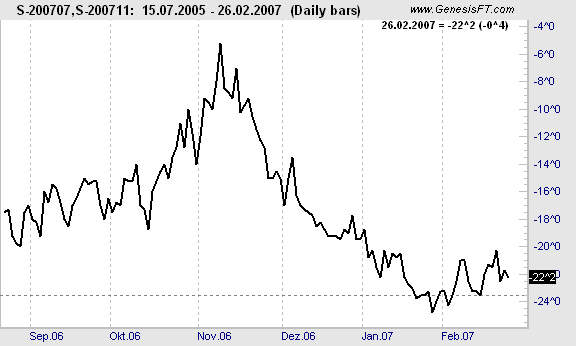
Here's how we suggested managing this trade:
02/06 Suggest entering MOC tomorrow.
02/07 In?Open equity: -$50 per contract.
For more information about our daily newsletter, visit our website:
http://tradingeducators.com/studentsonly.htm or visit our Spread Website to find out more about Traders Notebook
Questions or Comments? Please email us: support@spread-trading.com

Student's Question: "Andy, should I be looking at fundamentals?"
Andy: There are a number of reasons that cause many traders to favor technical analysis over fundamentals. For starters, fundamental traders tend to be commercial firms; that is, they are involved in the actual production or consumption of a commodity. Because of this, they have intimate, day-to-day knowledge of supply and demand. The commercial firms have information that most of us cannot afford to acquire. For example, are you able to check global soil conditions in an agricultural commodity you wish to trade? Can you check crop conditions? Commercial firms can and do check such things. They also check long-range weather forecasts, crop yield forecasts, and existing inventories.
Commercials have the best fundamental information on a market. You and I have a harder time getting pertinent fundamental information, especially in markets that are more thinly traded. Fundamental analysis generally requires a longer term trading horizon. Fundamentals tend to change more slowly than do technical conditions.
Technical traders tend to be almost everyone except the commercials, such as commodity pools, funds, and retail speculators. Speculators tend to trade in shorter time frames, and technical analysis may better serve shorter term traders. It's unlikely that fundamental analysis will tell you where beans may be next week, but technical analysis may do so.
The widespread use of technical analysis raises an interesting question - does technical analysis work because it actually helps interpret the markets, or does it work because it is widely followed, and thus creates self-fulfilling prophecies for the markets? Whichever it is, I don't care, as long as it works!
"I've called this manual "Trading Is a Business" because my purpose is to teach you
what I know about the business of making money in the markets.
I show you how to make your trading more profitable." -- Joe Ross.
 |
Joe's primary objective in this manual is to teach you how to trade profitably. In order to do that, he has to teach you to run your trading as a business, with an economic motivation and with sound management. Trading Is a Business shows you how to become a more successful trader, by showing you how to properly manage your trades, your risk, and yourself. |
Follow this link to read more about this great manual from
Trader, Author and Educator: Joe Ross
© 2007 by Trading Educators, Inc
Contact
Us
1509 Jackson Drive
Cedar Park, TX 78613
Phone: 800-476-7796 or 512-249-6930
You
can e-mail us: support@spread-trading.com
Office hours are Monday - Friday 9 A.M. to 5 P.M., U.S.C.T.
Unsubscribe or change subscription
To change your subscription or to unsubscribe, scroll past the end of this
newsletter to click the "unsubscribe" link.
Disclaimer:
The Commodity Futures Trading Commission has asked us to advise you that trading spreads is complex and carries a high degree of risk. While there is opportunity for incredible wealth building, there is also the risk of losing even more than you invested. Of course, that's not unlike most other businesses. But informed traders are the best traders!